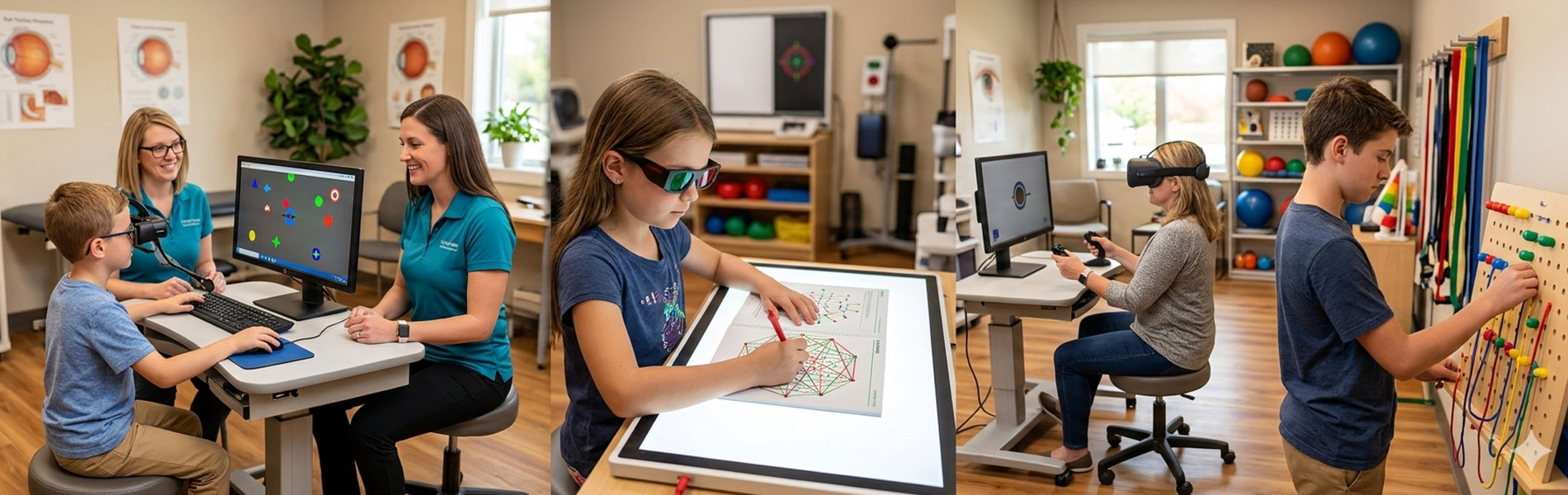
Who can benefit from Vision Therapy?
Vision Therapy is used to help with wide range of patients, from children to adults, who experience visual issues related to learning, reading, sports, and daily life, as well as those with challenges due to developmental delays or neurological damage/head trauma.
The benefits of visual therapy include reduced eye strain, better depth perception and binocular coordination, improved spatial awareness, and the ability to overcome problems like amblyopia (“lazy eye”), Strabismus (eye turn), Convergence and Accommodative instabilities.
When Is Vision Therapy Recommended?
- Reading Difficulties - Skips words or lines, difficulty with comprehension, or uses a finger to read.
- Visual Discomfort - Blurred or double vision, frequently rubs eyes and closing one eye when reading.
- Attention & Focus Issues - Short attention span, fidgets, or struggles to visualize what is read.
- Letter & Word Confusion - Reverses or confuses b, d, p, and q; difficulty recognizing letters or words.
- Posture & Positioning - Holds books too close, tilts head while reading, or struggles with eye coordination.
- Writing & Coordination Challenges - Sloppy handwriting or trouble staying within the lines.
- Eyestrain with Schoolwork - Experiences discomfort or headaches with sustained near tasks.

Common Problems Identified
Headaches, double vision, poor reading flow, weak focus, eye fatigue, letter reversals, and coordination difficulties.
“When vision works well, it leads and guides. When it does not, it interferes.” – Dr John Streff
Training stronger visual skills.
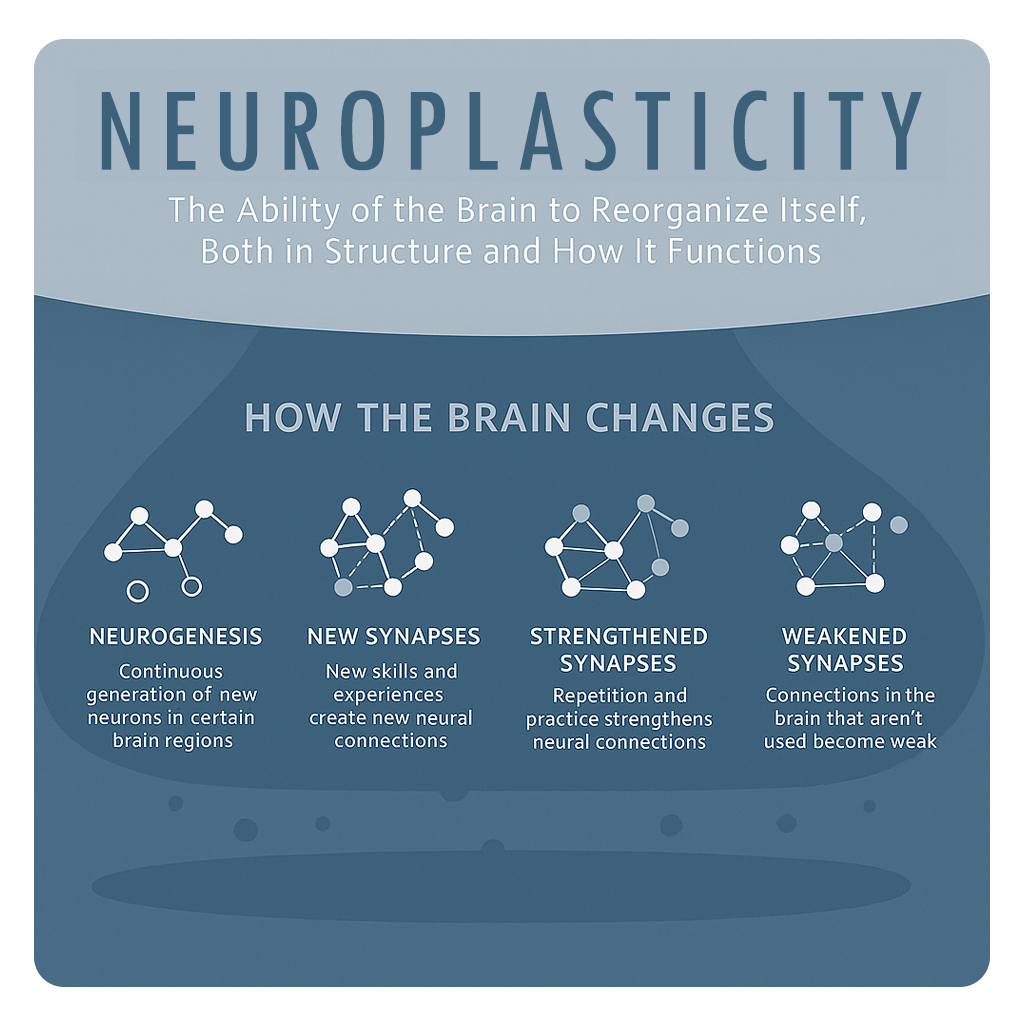
Vision Therapy is a personalised, non-invasive program supervised by a Behavioural Optometrist. It helps retrain how the eyes and brain work together, improving comfort, focus, and performance. Therapy uses exercises, lenses, prisms, and filters, supported by research in neuroplasticity.
What is Neuroplasticity?
Neuroplasticity is the brain’s ability to adapt, reorganize, and form new connections through learning and experience. It means the brain is not fixed, but continually reshaping itself when stimulated correctly. Vision Therapy is built on this principle: by engaging both the eyes and the brain through structured activities, new and stronger pathways can develop, leading to improved visual function and performance.
Skills Improved by Vision Therapy

Eye Tracking
Assesses how well the eyes move smoothly when reading or tracking a moving object.

Eye Focus
Assesses how easily the eyes shift focus from distance to near (board to book) and maintain clear vision during extended reading.

Depth Perception
Judge distances accurately for classroom, sport, driving, and everyday coordination.

Eye Teaming
Checks if both eyes work together smoothly and equally for clear, single vision.
Why See a Behavioural Optometrist?
Unlike a standard eye exam that mainly checks clarity, Behavioural Optometry looks at vision as part of overall development. It considers how the visual system supports movement, posture, spatial awareness, and how the brain uses vision for learning and daily performance.
One of the foundational ideas in Behavioural Optometry is Skeffington’s Four Circles - a model that explains vision as an interactive process, not just “eyesight”. The four areas work together to support:
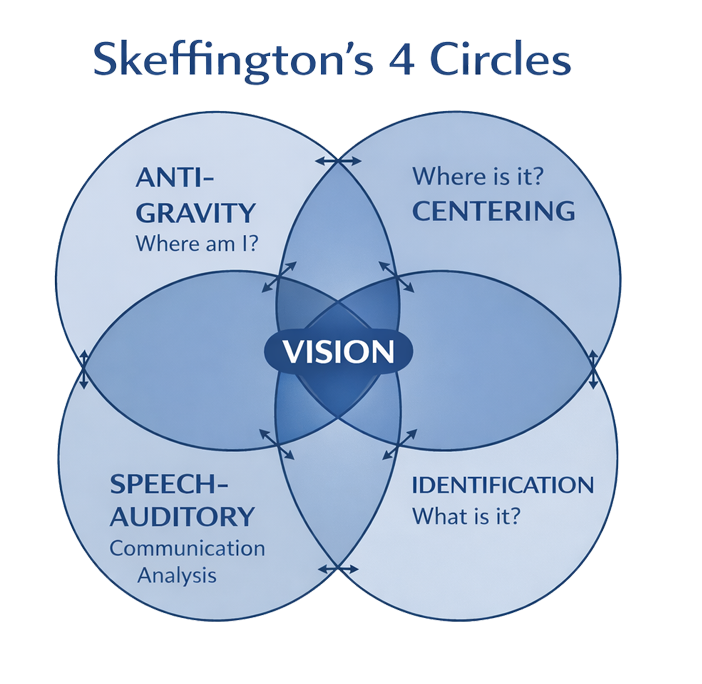
- Balance & posture - How the body stabilises and positions itself.
- Eye teaming & coordination - How well the eyes work together and track.
- Focusing & visual recognition - How we lock onto targets and make sense of what we see.
- Visual processing with communication - How vision supports understanding, learning, and response.
A functional vision examination assesses how these systems are working together - and how they may be affecting reading, attention, comfort, and performance at school, work, or sport.
Treatment Options
Vision therapy may include structured eye exercises, specialised lenses, prisms, coloured filters, and computer-based training programs. Treatment is typically completed over several months, combining regular in-practice sessions with guided daily home activities.
The goal is to improve visual accuracy, efficiency, coordination, and stamina so patients can perform comfortably and confidently.